Sunrooms
European Style Light Strip Sunroom
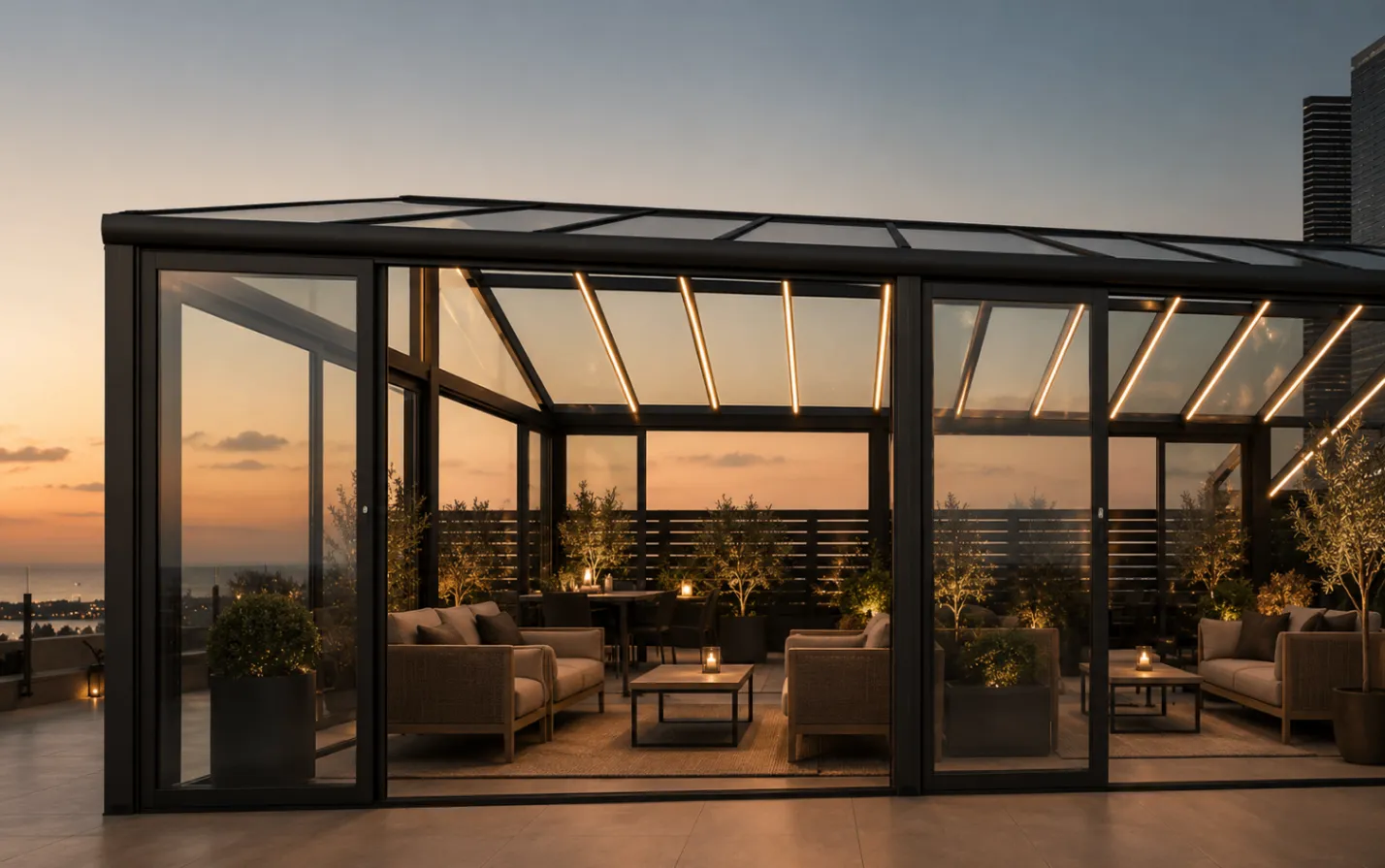
Elegant European-style aluminum sunroom with light strip roof for year-round outdoor living
View details
1 systems
A sunroom adds a bright, enclosed living space on a villa terrace or garden: a breakfast room, winter majlis or plant room. Alminyar supplies and installs aluminium sunrooms in Muscat, Dubai, Abu Dhabi and across the GCC, and this guide explains how to plan one that stays comfortable in the Gulf climate.
Sunrooms
Elegant European-style aluminum sunroom with light strip roof for year-round outdoor living
A sunroom, or glass room, is a lightweight aluminium structure with glazed walls and a glazed or partly glazed roof, attached to a house or standing in the garden. Unlike a pergola, it is fully enclosed, so it can be air-conditioned and used as part of the home.
In Oman and the UAE, homeowners typically use sunrooms as:
Because a sunroom is mostly glass, it behaves very differently from a masonry room. In the Gulf, the design question is less about capturing sunlight – there is plenty of it – and more about admitting daylight while controlling heat. Orientation, roof glass, shading and ventilation decide whether the room is a pleasure year-round or only in winter.
Before building, check local municipality requirements for extensions and setbacks; your consultant or contractor can advise on permits in Muscat, Dubai, Abu Dhabi or elsewhere.
Our sunroom system is a European-style light strip sunroom, with slim aluminium rafters and a light strip roof design that brings natural light deep into the space.
| Specification | European Light Strip Sunroom |
|---|---|
| Rafter depth | 120 mm |
| Profile alloy | 6063-T5 |
| Wall thickness | 2.5 mm |
| Roof glass | 6+20A+6 double glazing |
| Walls | Fixed and sliding panels |
| Hardware | MAIBAHO |
| Finish | Fluorocarbon + powder coating |
| Colours | White, Sand Grey, Black, Champagne Gold |
The frame is built with thermal break construction, and the catalogue performance ratings are thermal insulation Level 4, water tightness Level 6 and wind resistance Level 9.
Sliding side panels allow cross-ventilation on mild days, while fixed panels can be used where the wall faces a neighbour or the prevailing wind. Each sunroom is designed to the specific terrace or garden, so the layout, roof pitch and panel arrangement are agreed in the shop drawings rather than taken from a fixed kit.
This is the most important part of planning a sunroom in Oman or the UAE. A glass roof receives the strongest sun of any surface, and in summer an unprotected glass room can become uncomfortable very quickly.
Practical measures that make the difference:
Many families accept that the room is used most from October to April, with shading and air conditioning extending its use through summer.
The roof is what separates a sunroom from an ordinary glazed wall, and it needs specific attention in the Gulf.
Finishes. The sunroom is available in White, Sand Grey, Black and Champagne Gold with a fluorocarbon and powder-coated finish. White and Sand Grey frames absorb less heat and sit easily with traditional Omani and Emirati villa façades; Black gives a crisp, contemporary outline; Champagne Gold suits more decorative schemes.
Installation. Alminyar surveys the site, agrees the layout, roof pitch, door positions and glass specification, and prepares shop drawings before fabrication. On site, the base is checked for level, the frame is erected and anchored, roof and wall glass is set and sealed, and the junction with the existing building is flashed and sealed against water and dust.
Maintenance.
Yes, with the right design: a good orientation, solar-control double glazing on the roof, external shading and dedicated air conditioning. Without these measures, a glass room is best used in the cooler months from autumn to spring.
A pergola is an open shade structure. A sunroom is fully enclosed with glazed walls and roof, so it can be air-conditioned, kept free of dust and used as an indoor room.
Double glazing is the minimum; our sunroom uses a 6+20A+6 double-glazed roof. In the Gulf, add a solar-control Low-E coating, and consider laminated glass overhead for safety.
Requirements vary by municipality and by community. Check with the local municipality or your community management in Oman or the UAE before starting; your consultant or contractor can usually help with the application.
A suitable roof pitch lets rain wash some dust away, but periodic cleaning is still needed. Plan safe access from the start, use soft equipment and fresh water, and never walk directly on the glass.
Size and shape, roof glass specification, the number of sliding panels and doors, colour, shading and drainage details, foundations and site access. We quote each sunroom from a site survey and drawings.
Products
Send your plans or opening schedule. Our engineers recommend the right systems and reply within 2 business days.